Dear reader,
If you’ve spent most of your life just trying to get through the day… I see you.
Maybe you’ve learned how to keep it together on the outside.
You show up, you work hard, you take care of others, you do what needs to be done.
But inside, it can feel very different.
Rest feels uncomfortable.
Your mind doesn’t slow down.
You second guess your decisions.
You feel like you’re always “on,” always bracing for something.
That’s not a personality flaw.
That’s survival mode.
What Survival Mode Really Means
Survival mode isn’t something you choose.
It’s something your body learns.
When you grow up in environments where your emotions weren’t safe, where you had to be perfect, quiet, or hyper-aware of others… your brain adapts.
It says, “Stay alert. Stay in control. Don’t mess up.”
And for a while, that works.
It helps you succeed. It helps you avoid pain. It helps you stay safe.
But over time, it becomes exhausting.
Because your body never gets the message that it’s okay to relax.
How Survival Mode Shows Up in Your Life
You might notice it in ways like:
Constant overthinking and decision fatigue
Feeling anxious even during calm moments
Struggling to trust your instincts
People pleasing or avoiding conflict
Feeling guilty for resting or slowing down
Trying to control everything so nothing goes wrong
And the hardest part?
Even when life gets better… your body still feels like it has to stay on guard.
Why Healing Childhood Trauma Changes Everything
Healing childhood trauma isn’t about going back and reliving every painful moment.
It’s about understanding why your system learned to function this way in the first place.
When you begin that process, something shifts.
You stop asking, “What’s wrong with me?”
And you start asking, “What happened to me?”
That question opens the door to compassion.
And from there, real change becomes possible.
Moving Out of Survival Mode
This doesn’t happen overnight.
And it doesn’t happen by forcing yourself to “just think positive.”
It happens through small, consistent moments of awareness and connection.
In therapy, we begin to:
Understand your patterns
You start to recognize where your thoughts and reactions come from.
Reconnect with your body
You learn to notice what you feel instead of pushing it away.
Process what was never processed
The emotions you didn’t have space for before finally get acknowledged.
Create safety within yourself
Not based on control, but on trust.


What Self-Trust Actually Feels Like
Self-trust isn’t about always making the perfect decision.
It’s about knowing that you can handle whatever comes next.
It looks like:
Making choices without spiraling for hours or days
Listening to your intuition instead of ignoring it
Setting boundaries without feeling overwhelming guilt
Letting yourself rest without needing to earn it
Feeling your emotions without being controlled by them
It’s a quieter way of living.
A more grounded way of being.
You Don’t Have to Stay in Survival Mode
I know it can feel like this is just “how you are.”
But it’s not who you are.
It’s how you learned to cope.
And coping strategies can change.
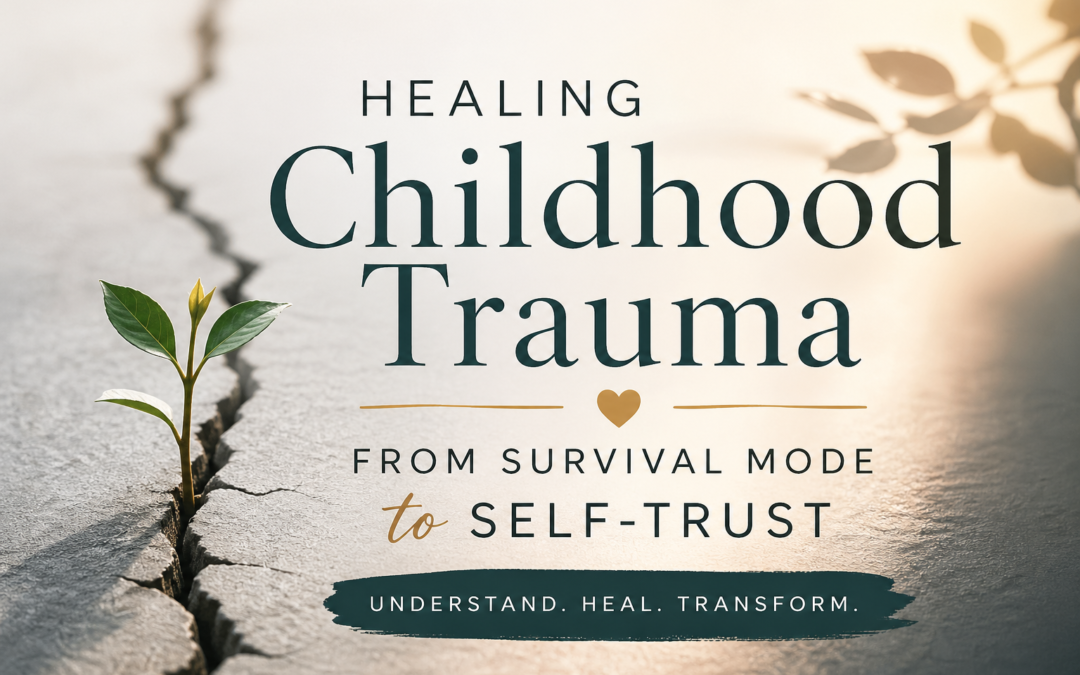
Healing from childhood trauma gives you the opportunity to build something different.
Not a perfect life.
But a life where you feel more like yourself.
The Hard Truth About Healing
There will be moments where it feels uncomfortable.
Unbearable even.
You’ll want to give up and go back to what feels easy.
Familiar.
There will be times where old patterns show up again.
Why wouldn’t they?
You’ve been living that way for years.
That doesn’t mean you’re failing.
It means the exact opposite actually.
It means you’re noticing.
It means you’re trying.
Doing something different.
And noticing, trying something different, is where change begins.
You Deserve to Feel Safe in Your Own Life
Not just safe on the outside.
Safe inside your own mind.
Safe in your own body.
Safe to be who you are without overthinking every move.
If you’ve been living in survival mode for a long time, it makes sense that slowing down feels unfamiliar.
But unfamiliar doesn’t mean it’s wrong.
It might just mean new.
If You’re Ready to Take the Next Step
You don’t have to figure this out on your own.
Therapy can help you understand your patterns, reconnect with yourself, and begin building that sense of trust from the inside out.
You’re allowed to move at your own pace.
You’re allowed to take this one step at a time.
And you’re allowed to want more than just getting through the day.
With you,
Tammy | Empowering Optimism Therapy