
Somatic and Mindfulness Therapy Tools
Somatic Tools
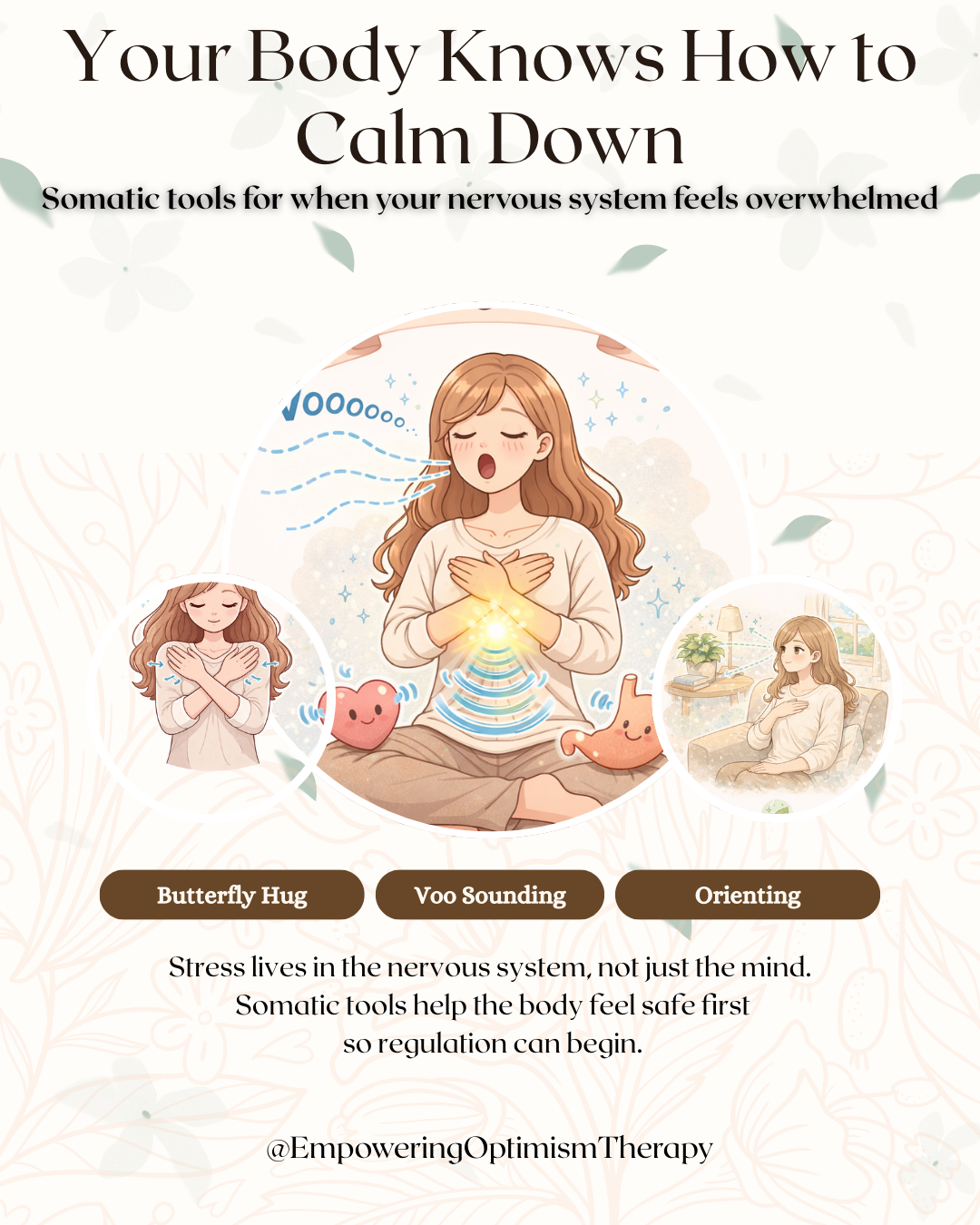
1. The Butterfly Hug
Developed for EMDR therapy, this is a self-soothing tool that uses bilateral stimulation to calm the nervous system.
- How to do it: Cross your arms over your chest, resting your hands on opposite shoulders or upper arms. Alternately tap your left and right hands rhythmically, like the flapping of butterfly wings.
- Why it works: The alternating rhythm engages both hemispheres of the brain, helping to lower arousal and process distressing emotions.
2. Voo Sounding
This is a core exercise in Somatic Experiencing® used to stimulate the vagus nerve, which is responsible for the body’s “rest and digest” state.
- How to do it: Inhale deeply into your belly. On the exhale, make a long, low-frequency “Voooooo” sound (like a foghorn). Focus on feeling the vibration in your chest, throat, and abdomen.
- Why it works: The vibration physically massages the internal organs and signals to the brain that it is safe to relax.
3. Orienting
When we are stressed, our vision often tunnels. Orienting helps your brain realize you are safe in your current environment.
- How to do it: Let your eyes wander slowly around the room without a specific goal. Notice an object that feels neutral or pleasant—perhaps a plant, a lamp, or a picture. Allow your gaze to rest there and notice the colors and textures.
- Why it works: It breaks the cycle of “internal” scanning for threats and brings you back to the “external” present moment.
4. Pendulation
This technique teaches you how to move between areas of tension and areas of ease.
- How to do it: First, identify a part of your body that feels tense or “tight” (e.g., your chest). Then, scan for a part of your body that feels neutral or relaxed (e.g., your big toe or your elbow). Gently shift your attention back and forth between the two areas.
- Why it works: It prevents you from becoming overwhelmed by pain or stress by showing your brain that “ease” still exists alongside “discomfort.”
5. Shaking (Therapeutic Tremoring)
This mimics how animals in the wild release energy after a stressful event.
- How to do it: Stand up and begin gently shaking your hands, then your arms, and finally your legs and torso. You can start slow and increase the intensity, letting your whole body be loose for 1–2 minutes.
- Why it works: It helps discharge “trapped” fight-or-flight energy and physically resets the nervous system.
Who is Somatic Therapy best for?
Somatic therapy is most effective for people who feel that “talking isn’t enough.” While traditional talk therapy (like CBT) works from the top-down (using the mind to change the body), somatic therapy works bottom-up (using the body to change the mind)
Experience/ Example:
I had a client I was working, she was having explosive outbursts and reactions towards her daughter and obviously didn’t want to react this way anymore. We utilized somatic movement as a coping tool when client would feel her reactions start to come up in those moments with her daughter. Overtime, my client was able to calm herself and regulate herself enough that her reactions significantly reduced and she was able to respond to her daughter, rather than react. After several sessions of working together when my client was able to regulate, we identified her reactions mostly happened when she was scared for her daughter’s safety in public places. We were able to connect this fear to my client’s own childhood and trauma she experienced.
Mindfulness Tools
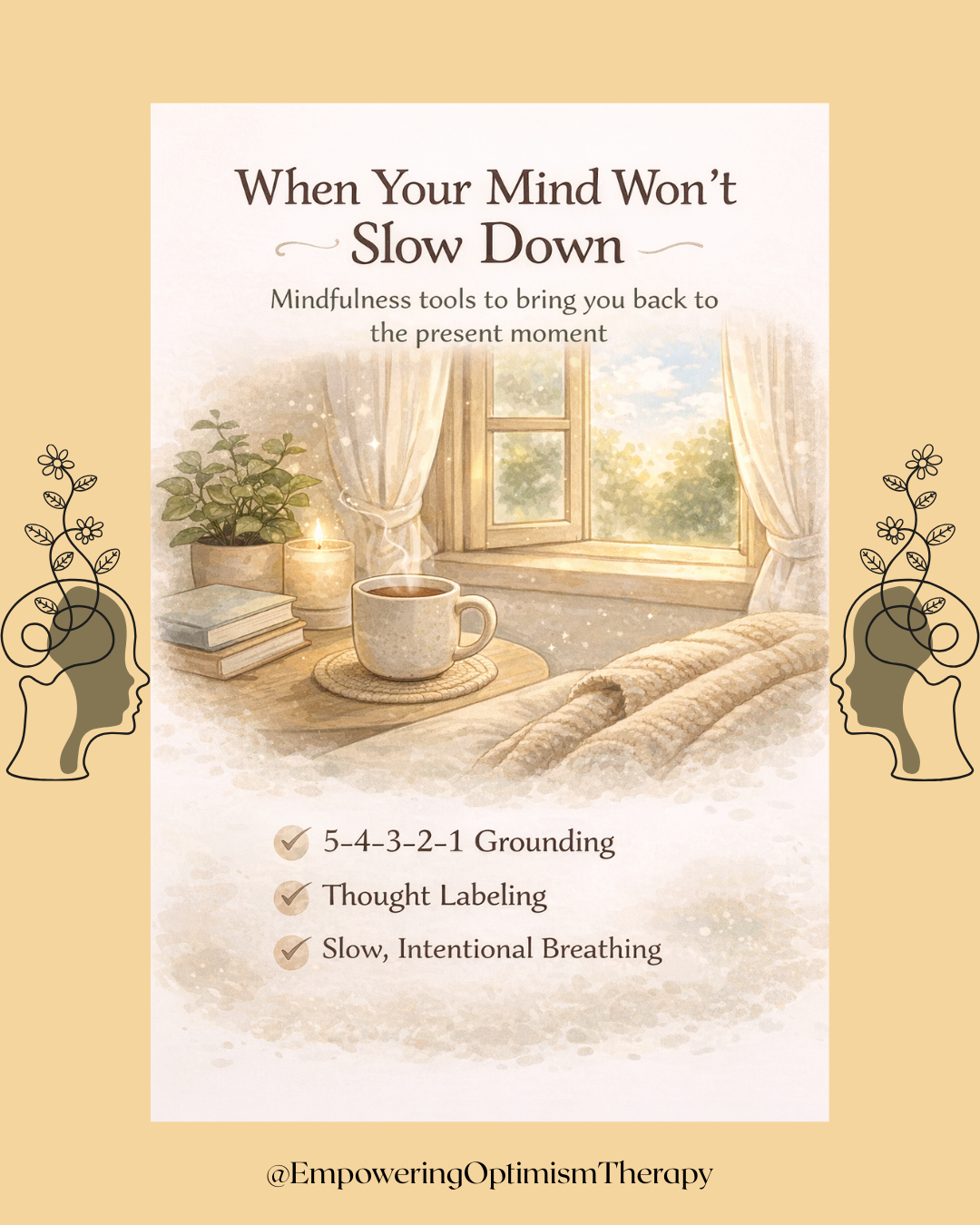
1. The 5-4-3-2-1 Grounding Technique
This is a sensory awareness tool used to pull the mind out of anxious “future-tripping” or “past-dwelling” and back into the physical present.
- Acknowledge 5 things you see: (e.g., a blue pen, a crack in the wall).
- Acknowledge 4 things you can touch: (e.g., the fabric of your chair, your cold coffee cup).
- Acknowledge 3 things you hear: (e.g., a ticking clock, distant traffic).
- Acknowledge 2 things you can smell: (e.g., old books, laundry detergent).
- Acknowledge 1 thing you can taste: (e.g., toothpaste, the inside of your mouth).
2. The STOP Technique
This is a “micro-practice” used to break the cycle of automatic, habitual reactions during a stressful moment.
- S – Stop: Whatever you are doing, just pause for a second.
- T – Take a breath: Reconnect with your breathing to anchor yourself in the moment.
- O – Observe: Notice what is happening inside you (thoughts, feelings) and outside you (your environment) without judging it as “good” or “bad.”
- P – Proceed: Continue with your day, but with more intentionality and awareness.
3. Thought Labeling (Mental Noting)
In therapy, this helps create “cognitive defusion”—the ability to see your thoughts as just “mental events” rather than absolute truths.
- How to do it: When a thought arises, instead of engaging with it, silently label it. If you’re worried about work, say to yourself, “I’m having a thought about work.” If you’re feeling judged, say, “Judgment is happening.”
- Why it works: It shifts you from being inside the emotion to being the observer of the emotion.
4. RAIN Practice
Popularized by psychologist Tara Brach, this is a tool for processing difficult emotions with compassion.
- R – Recognize: Notice that a strong emotion is present (e.g., “I feel angry”).
- A – Allow: Let the emotion be there without trying to fix it or push it away.
- I – Investigate: Notice how the emotion feels in the body. Is it a tightness? A heat? A hollowness?
- N – Nurture: Offer yourself a kind thought or a self-soothing gesture (e.g., “This is a hard moment, it’s okay to feel this”).
5. The 3-Minute Breathing Space
This is a core tool from Mindfulness-Based Cognitive Therapy (MBCT) used to bridge formal meditation with everyday life.
- Minute 1: Become aware of your current experience (thoughts, feelings, and body sensations).
- Minute 2: Narrow your focus entirely to the breath at the belly or chest.
- Minute 3: Expand your awareness back out to the whole body and the room around you.
Who is Mindfulness best for?
Mindfulness is best for people who “think too much” and often ruminate on their thoughts – People who tend to intellectualize their emotions rather than experience them. Example, people with depression, ADHD, Focus issues, chronic pain or illness, high-stress professionals or students.
Experience/ Example:
I have a client who works in the medical field in a high stress job. She often finds herself overwhelmed, tired, and “too lazy” to get anything done after work. During our appointments I use mindful visualizations and tools to help my client calm and regulate her body. Once my client feels calm, we often find her feelings of overwhelm and thoughts of being “too lazy” are because she had a very intense and trigger day at work. We use this tool often and my client is guided back to her routines and daily tools that help her recognize her need for self care or simple household tasks to reduce the overall stress.
Somatic and mindfulness therapy tools remind us that healing does not have to be complicated or overwhelming. Whether you are learning to calm your nervous system through movement and breath, or creating space between your thoughts and emotions through mindfulness, these practices offer gentle ways to reconnect with yourself in moments of stress. Over time, consistently using these tools can help shift reactions into responses, increase emotional awareness, and build a greater sense of safety within your body. If you find that talk therapy alone has not felt like enough, integrating somatic and mindfulness approaches can create deeper, more lasting change by addressing both the mind and the body together.